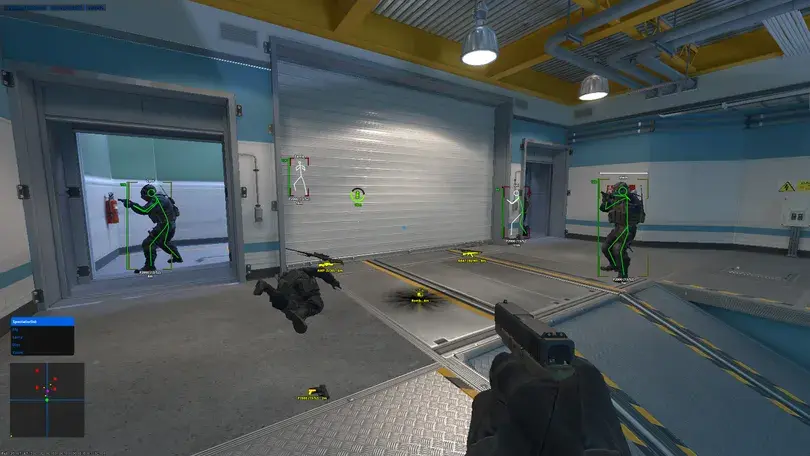
Counter-Strike 2 does not use a single anti-cheat. It runs four separate systems that overlap, and most of the confusion in forum threads comes from people using one name for all of them. Valve Anti-Cheat scans your machine. Trusted Mode restricts what other software can do to the game client. VACnet watches how you play. VAC Live is the part that boots someone mid-round and cancels the match.
Understanding which layer is which matters, because they fail and succeed for completely different reasons. A cheat that survives signature scanning forever can still get its user banned in a week by the behavioural model, and that is exactly what has been happening through 2026.
VAC: the signature scanner
This is the original, and it has been part of Counter-Strike for over twenty years. When the game launches, VAC checks memory and running processes against a set of known cheat signatures. If it finds a match, the account is flagged.
Two things about it are widely misunderstood. First, bans are usually delayed. Valve batches them into waves rather than banning on detection, which denies cheat developers the immediate feedback they would need to work out exactly what tripped the scan. Second, it only knows what it has already seen. A private build that has never been submitted anywhere is invisible to signature scanning until somebody hands it over or it gets popular enough to be worth reverse-engineering.
That is why signature evasion, on its own, stopped being an interesting problem years ago. It is solved, and it is not the layer that catches people.
Trusted Mode: restricting the client
CS2 launches in Trusted Mode by default. In simple terms, it limits how third-party software is allowed to interact with the game process. Unsigned modules attempting to hook into or inject code into the client get blocked, and in some cases the session refuses to start properly at all.
You can launch outside Trusted Mode — legitimate reasons exist, overlays and capture tools among them — but doing so is itself a signal. It does not ban you. It changes how much scrutiny everything else applies.
Trusted Mode is the reason the market drifted towards external and DMA-based approaches. If you cannot inject, you read memory from outside, or from another machine entirely.
VACnet: scoring how you play
This is the layer worth paying attention to. VACnet is server-side machine learning. It does not care what is installed on your computer. It looks at what your crosshair did.
Valve described it publicly at GDC 2018 and has said very little since, which means that talk is still the best primary source available. The model was trained on Overwatch verdicts — the human jury system — and analyses sequences of shots, examining reaction timing, crosshair movement before and after a kill, shot distribution and outcome patterns against a very large dataset of normal play. The numbers Valve gave at the time were striking: human-submitted Overwatch cases converted to convictions 15 to 30 percent of the time, while VACnet-submitted cases converted at 80 to 95 percent.
The feedback loop is the clever part. VACnet submits cases, humans judge them, those verdicts feed the next training run. If a cheat developer works out which windows the model examines and suppresses the signal inside them, human reviewers still recognise the behaviour, still convict, and the model learns the new pattern on the next retrain. You cannot out-wait a system that improves from being beaten.
VAC Live: acting in real time
Shipped in June 2023, VAC Live is the enforcement layer sitting on top of VACnet. Where the original design queued a case for review after the match, VAC Live can intervene during it — remove the player, cancel the match, end the round for everyone in the server. If you have ever had a game stop dead with a system message, that was this.
Valve's own developer documentation now refers to VAC Live as the system formerly known as VACnet, which is where the naming gets messy. The community tends to call the CS2 generation VACnet 3.0. Functionally: VACnet is the model, VAC Live is what the model is allowed to do.
Where things stand in 2026
Two events this year are worth knowing about if you are trying to read the current state of things.
In March, Valve carried out the largest single ban wave in CS2 history, removing close to a million accounts at once. The number is real, but players pointed out immediately that it was overwhelmingly farming bots rather than the spinbotters and closet cheaters who actually ruin competitive games. Big number, limited effect on your Premier queue.
In late July, the patch notes carried a single line: a bug was fixed that had allowed malicious players to avoid being processed by VACnet. That is a bypass fix, not a new system. But the effect was immediate and visible — cheat forums filled with reports of mid-match bans within minutes, and blatant rage cheating genuinely dropped off for a while. If VACnet never received usable data on a player, VAC Live had nothing to act on. Closing that hole restored detection to roughly where it had been, rather than pushing it somewhere new.
The honest summary is that CS2's anti-cheat problem is quieter than it was, not solved. Wallhackers shooting through smoke are still in high-Elo lobbies.
What this means in practice
If you take one thing from this: the layer most likely to end your account is the one watching your behaviour, not the one scanning your memory.
- Signature evasion is table stakes. Every serious provider clears it, and clearing it protects you from the weakest layer.
- Behavioural detection does not care how well a cheat hides. It cares whether your shots are humanly plausible over a few hundred rounds.
- Rage settings are the fastest route to a ban. Wide FOV, zero smoothing and shooting through walls generate exactly the statistical signature the model was trained on.
- Reports still matter. Human review is what feeds the retraining loop, so playing in a way that makes people report you feeds the system directly.
- Nothing here is permanent. Any provider claiming a guaranteed undetected build is describing a moment in time, whether they say so or not.
If you want the third-party side of the picture — the kernel driver, the TPM and Secure Boot requirements, and the machine-learning input layer Faceit turned on this August — that is a different stack with different rules, and we covered it separately in our breakdown of how Faceit Anti-Cheat works in 2026.