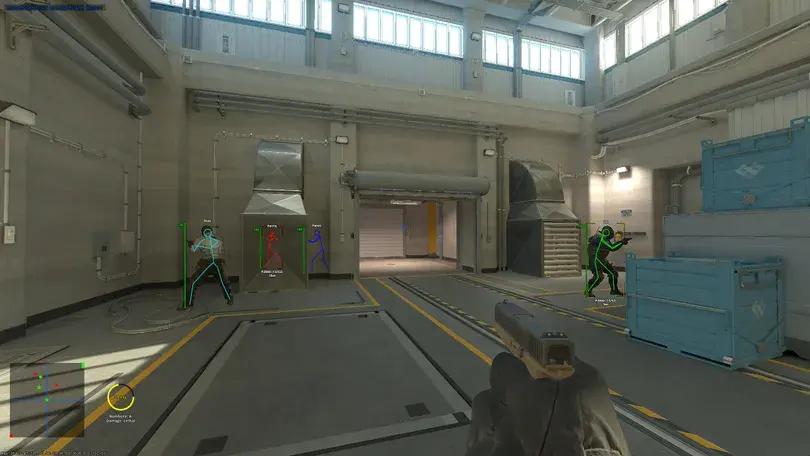
You cannot tell from inside the round. That is the part most people skip. Live, you are looking at one angle, at one moment, with a death screen and a lot of adrenaline — which is roughly the worst possible condition for judging whether someone had information they should not have had.
The only place a cheat accusation can actually be settled is the demo, in free-look, watching the suspect rather than the ball. It takes about ten minutes and it will change your hit rate on these calls dramatically. It will also, if you are honest with yourself, clear a lot of people you were certain about.
Getting the demo open
Download the match from your match history, then play it back and switch to free-look. Lock the camera onto the player you are suspicious of and ignore the round entirely — do not watch the fight, watch them.
Two habits make this far more productive. Run it at quarter or half speed for anything involving aim, because a snap that looks damning at full speed frequently turns out to be a normal correction. And watch the same round twice: once following the suspect, once following whoever they killed. You need to know what information was legitimately available before you can judge whether they had more.
What actually holds up
Tracking through geometry
The strongest single signal. Watch the crosshair while the suspect is behind a wall with no line of sight. Does it drift along with someone on the other side? Not snap to them when they appear — track them while they are invisible.
Legitimate players pre-aim where they expect someone to be, and that looks like a static crosshair parked on an angle. Following a moving target through solid geometry is a different motion entirely, and once you have seen the difference a few times it is unmistakable.
Attention that arrives too early
Look at when they turn, not how fast. A player repeatedly starting a turn towards a flank a beat before there is any sound cue is showing you something. So is someone who stops holding an angle and repositions at precisely the moment the enemy commits somewhere else.
This one requires the second viewing. You need to confirm there was genuinely no footstep, no utility, no teammate call and no radar contact that would explain it. Very often there was, and you would have missed it watching from one side.
Utility thrown at people, not at places
Counter-Strike players learn line-ups. Flashes and molotovs land on the same spots thousands of times. What is harder to explain is utility that consistently lands on where a specific player happens to be standing, especially in positions nobody would default to, and especially when it happens more than once in a half.
The shape of the aim, not the speed
Fast flicks are not evidence. Good players flick fast. What you are looking for is the curve: a human flick overshoots slightly and corrects back, and the correction has a wobble to it. Heavy aim assistance tends to produce a path that is too direct, or one that decelerates into the target with a smoothness that does not look like hand movement.
The other tell is consistency under pressure. Everyone's aim degrades when they are surprised, low on health, or already mid-spray. Aim that is exactly as clean in a panic as it is on a held angle is unusual.
What means nothing
Half of what gets called out in chat is noise. Ruling these out will save you a lot of wasted anger:
- A single impossible-looking flick. Everyone has a handful of these. One clip is not a case.
- Prefiring a common angle. That is called map knowledge and it is most of what improving at this game consists of.
- High headshot percentage. Counter-Strike rewards head-level crosshair placement. Strong players sit high naturally.
- Wallbangs through known spots. Pro demos are full of these, and the angles that work are well documented.
- A smurf-looking account. New account plus high skill equals a smurf far more often than it equals a cheater.
- Getting killed through smoke. Check the demo for whether a teammate had vision, or whether they were spraying a pre-planned line.
Closet cheating is the hard case
Obvious cheating is easy to identify and largely handled — spinbots do not last long, and Valve's July 2026 fix to a VACnet processing bypass visibly thinned out rage cheating for a while.
The category that survives is the player using a small amount of information very selectively. One rotation per half. One pre-aim in a round that actually matters. That person will beat a ten-minute demo review, and honestly, they will often beat a much longer one. If you cannot find a clear pattern across several rounds, the correct conclusion is that you do not know — not that you found nothing because they are good at hiding it.
What to do once you are reasonably sure
- Report in client, and use the specific category rather than the generic one. Reports feed the human review process, and those verdicts are what retrain Valve's behavioural model.
- Report on the platform too if the match was on Faceit or ESEA. Their systems are separate from Valve's and their reviewers see different signals.
- Keep the demo. If it goes anywhere, someone will want the file and match ID, not a clip of the kill.
- Stop talking about it in the match. Nothing about calling it out mid-game improves your outcome, and it tends to make the rest of your team worse.
Enforcement is slower than you want it to be, and that is intentional — Valve batches bans in waves so cheat developers cannot use instant feedback to work out what triggered detection. A report that appears to do nothing for three weeks has not necessarily done nothing.
If you want the detail on which system does the catching, we broke down VAC, Trusted Mode, VACnet and VAC Live in a separate piece on what anti-cheat CS2 uses.